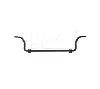
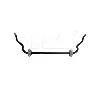
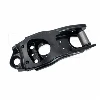
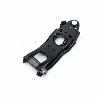
The function of the heavy-duty truck's V-type thrust rod is to prevent the front and rear axles from shifting forward and backward, as well as to prevent left and right displacement. This is because when the car turns, the middle and rear axles may experience left and right displacement, causing friction between the leaf spring and the tire. In severe cases, it can lead to premature tire wear and even tire blowouts.
The function of the thrust rod is to prevent bridge displacement. Generally, a straight thrust rod can only prevent the front and rear axles from shifting forward and backward, while a V-shaped thrust rod can not only prevent the front and rear axles from shifting forward and backward, but also prevent left and right displacement. This is because when a car turns, the middle and rear axles may experience left and right displacement, causing friction between the leaf spring and the tire. In severe cases, it can lead to premature tire wear and even a serious tire blowout accident.
The lateral thrust rod is a torsion bar spring made of spring steel, which is shaped like a "U" and is placed horizontally on the front and rear walls of a car. In the middle of the thrust rod body, it is hinged to the frame with a sleeve, and the two ends of the thrust rod are respectively fixed on the left and right suspensions. Only when the vehicle body undergoes vertical movement and the suspension deformation on both sides is the same, the lateral thrust rod will not function.
When the car body tilts, the suspension jumps on both sides are inconsistent, and the lateral thrust rod will twist. The elasticity of the rod body becomes the resistance that continues to cause the car to roll, ultimately playing a role in lateral stability.