

Hey there! As a front anti roll bar supplier, I often get asked about how to measure the stiffness of a front anti roll bar. It's a crucial aspect, especially for those who are into customizing their vehicles or need to optimize the handling performance. In this blog, I'll share some insights on how to go about measuring the stiffness of these bars.
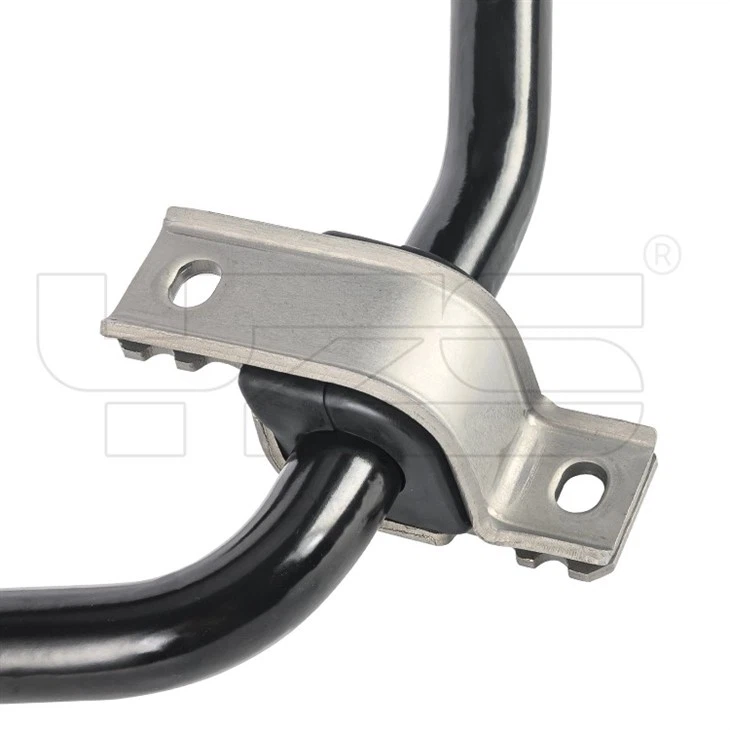
First off, let's understand what the stiffness of a front anti roll bar means. The stiffness, often referred to as the spring rate, determines how much the bar will resist twisting when the vehicle is going through a turn. A stiffer bar will reduce body roll, which can improve the vehicle's handling and stability. On the other hand, a softer bar might provide a more comfortable ride but may not offer the same level of handling precision.
One of the most common ways to measure the stiffness of a front anti roll bar is through a static test. This involves applying a known force to the bar and measuring the resulting deflection. To do this, you'll need a few tools. A hydraulic press or a similar device that can apply a controlled force is essential. You'll also need a way to measure the deflection, such as a dial indicator.
Here's a step - by - step guide on how to conduct a static test:
- Mount the anti roll bar securely. You want to make sure it's held in a way that mimics its real - world installation as closely as possible. This might involve using fixtures that replicate the mounting points on the vehicle.
- Apply a known force. Using the hydraulic press, apply a specific amount of force to the end of the bar. It's important to start with a relatively small force and gradually increase it in increments.
- Measure the deflection. As you apply the force, use the dial indicator to measure how much the bar deflects. Record the force applied and the corresponding deflection at each increment.
- Calculate the stiffness. The stiffness (k) of the bar can be calculated using Hooke's Law, which states that F = kx, where F is the force applied, k is the stiffness, and x is the deflection. Rearranging the formula, we get k = F/x. By dividing the force by the deflection at each increment, you can calculate the stiffness of the bar.
Another method to measure the stiffness is through a dynamic test. This test is a bit more complex and usually requires more specialized equipment. It involves subjecting the anti roll bar to dynamic forces similar to those it would experience during normal driving.
In a dynamic test, you can use a test rig that simulates the motion of the vehicle's suspension. The bar is mounted on the rig, and a series of vibrations and forces are applied to it. Sensors are used to measure the forces and the resulting deflections over time. This method can provide a more accurate representation of how the bar will perform in real - world conditions.
However, dynamic testing is not always practical for everyone. It requires expensive equipment and a dedicated testing facility. For most people, the static test is a more accessible option.
Now, let's talk about why measuring the stiffness of a front anti roll bar is so important. For us as suppliers, it helps us ensure that the bars we produce meet the required specifications. Different vehicles have different requirements for anti roll bar stiffness, depending on factors such as the vehicle's weight, suspension design, and intended use.
For customers, knowing the stiffness of the anti roll bar can help them make informed decisions when it comes to upgrading or replacing their existing bars. If you're into racing or high - performance driving, you might want a stiffer bar to improve cornering performance. On the other hand, if you're looking for a more comfortable daily driver, a softer bar could be a better choice.
At our company, we offer a wide range of front anti roll bars to suit different needs. For example, we have the NEW ARRIVAL Front Solid Sway Bar Stabilizer Antiroll Bar For Toyota RAV4 2000 - 2005 FROTIS ACA21. This bar is designed to provide optimal stiffness for the Toyota RAV4, improving its handling and stability.
We also have the Rear Anti Roll Bar for Citroen Peugeot Fiat. This bar is engineered to work in harmony with the front anti roll bar, creating a balanced suspension setup for these vehicles.
And for those looking for a great deal, we have the Wholesale Price Front Sway Bar For 威霆 V Class (W448) 2016 - A4473231565 A 447 323 15 65. It offers high - quality performance at a competitive price.
If you're interested in our products or have any questions about measuring the stiffness of front anti roll bars, don't hesitate to reach out. We're here to help you find the perfect anti roll bar for your vehicle and ensure that you get the best performance possible. Whether you're a professional mechanic, a car enthusiast, or a fleet manager, we have the expertise and products to meet your needs.

In conclusion, measuring the stiffness of a front anti roll bar is an important process that can have a significant impact on a vehicle's handling and performance. Whether you choose to use a static or dynamic test, the key is to ensure that the bar you're using is appropriate for your vehicle and driving style. And if you're in the market for a new front anti roll bar, we're here to assist you.
References
- "Automotive Suspension Systems" by Thomas D. Gillespie
- "Fundamentals of Vehicle Dynamics" by Robert L. Nitzsche


