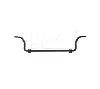
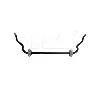
The roll angle of the suspension is one of the main factors affecting the static roll stability of a car, and directly affects other performance indicators of car handling stability, such as understeer, neutral turning point, and lateral acceleration. To increase the roll stiffness of the suspension, most cars are now equipped with a stabilizer bar.
For the lateral stabilizer bar, firstly, the design index directly related to operational stability is its equivalent roll stiffness at the wheel, and secondly, its own roll stiffness; Secondly, the design of the stabilizer bar must meet the strength requirements; Thirdly, the weight of the stabilizer bar should be minimized as much as possible.
When the vehicle body only moves vertically and the two suspensions deform equally, the stabilizer bar rotates freely within the sleeve and does not work. When the suspension on both sides deforms unevenly and the vehicle tilts laterally on the road surface, one side of the frame moves closer to the spring support, and the end of the stabilizer bar on that side moves upward relative to the frame, while the other side of the frame moves away from the spring support, and the corresponding end of the stabilizer bar moves downward relative to the frame. However, when the vehicle and the frame tilt, the middle of the lateral stabilizer bar does not move relative to the frame. When the vehicle tilts, the longitudinal parts on both sides of the stabilizer bar deflect in different directions, causing the stabilizer bar to twist. The torsional internal torque generated by the elastic stabilizer bar hinders the deformation of the suspension spring, thereby reducing the lateral tilt and lateral angular vibration of the vehicle body.