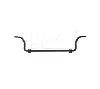
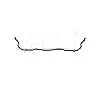
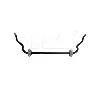
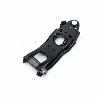
Lateral stabilizer bar. The lateral stabilizer bar can prevent excessive lateral tilting of the vehicle body. Using the lateral stabilizer bar to adjust the lateral stiffness of the suspension can give the car steering stability characteristics and improve its handling stability.
Modern car suspensions are very soft, meaning their natural frequencies are very low. In order to improve the lateral stiffness of the suspension and reduce lateral tilt, lateral stabilizer bars are often added to the suspension to ensure good handling stability.
The horizontal stabilizer bar 2 made of spring steel is flat and U-shaped, and is installed horizontally at the front or rear end of the car (some cars also have horizontal stabilizer bars installed at the front and rear). The two ends of rod 3 are freely supported in two rubber sleeves, which are fixed to the frame. The ends of the longitudinal sections on both sides of the lateral stabilizer bar are connected to the spring supports on the lower suspension arm through support rods.
When the deformation of the suspension on both sides is the same, the lateral stabilizer bar does not work. When the suspension deformation on both sides is unequal, that is, when the vehicle body tilts laterally relative to the road surface, one side of the frame moves closer to the spring support, and the end of the stabilizer bar on the same side moves upwards with the frame, while the other side of the frame moves away from the spring seat, and the corresponding end of the stabilizer bar moves downwards relative to the frame. The middle of the stabilizer bar does not have relative motion with the frame, and the longitudinal parts on both sides of the stabilizer bar deflect in different directions, causing the stabilizer bar to be twisted. The internal torque generated by the torsion of the elastic stabilizer bar hinders the deformation of the suspension spring, reducing the lateral tilt and lateral angular vibration of the vehicle body.